Vision
The Netherlands is in the middle of an energy transition. This energy transition must ensure that the energy supply must be (almost) completely sustainable by 2050. Energy sources are then renewable, instead of the combustion of fossil fuels. Renewable energy sources are inexhaustible, unlike fossil fuels which are not renewable. That is why the municipality of West Betuwe has also taken steps to investigate whether and how natural gas can be replaced by natural energy sources, such as wind and water. The Mooi Wonen In Enspijk foundation already in 2012 expressed the ambition to be energy neutral by 2030 in its Village Plan. In addition to this fact and the fact that Enspijk is located along the river the Linge, Enspijk has been selected as a pilot location to develop aquathermal energy. The development of a communal heating system, in which heat is extracted from the Linge, can serve as an example for other municipalities and organisations.
Common goals
The working group Duurzame Warmte Enspijk (DWE) was established to research the possibilities for realising the development of aquathermal energy from the Linge. The working group consists of a group of enthusiastic villagers who invest a lot of their free time in this.
The goals of the municipality of West Betuwe and DWE are:
- Developing a sustainable energy supply;
- Playing a pioneering role in the energy transition of the municipality of West Betuwe;
- Developing a plan which can be replicated by others.
The aim is to offer the villagers a sustainable energy source, where the energy price is fixed for a long time (>20 years). As a result, residents will be less affected by fluctuations in energy prices. Residents who care about the climate can use this to connect to a climate-friendly energy supply.
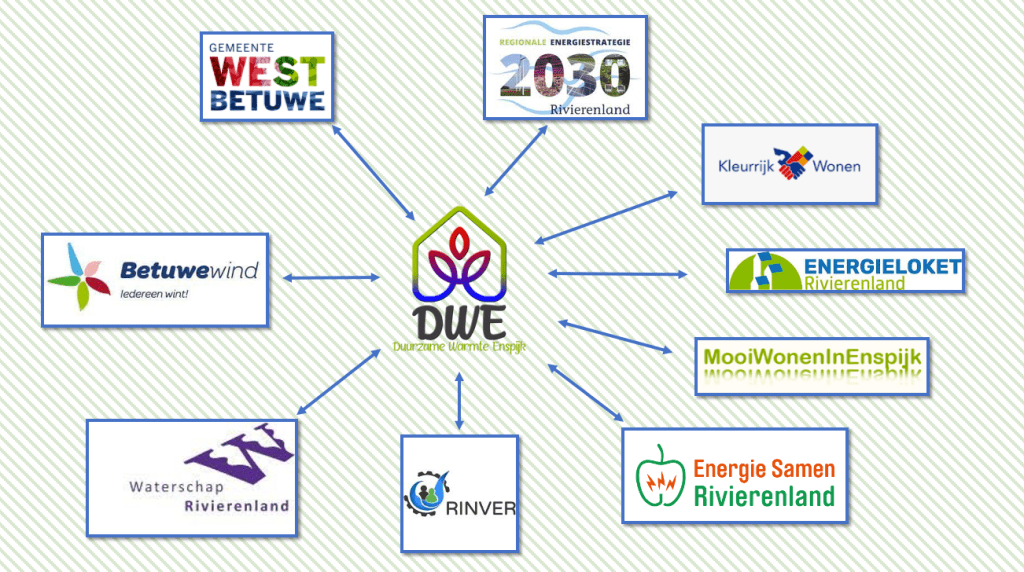
We have established a network of collaborating organisations, all of which are involved in the realisation of our communal heating system in Enspijk.
The proces: past, present, future
From November 2021 to March 2022, research was conducted into what the preferred scenario for the energy transition in Enspijk could be.
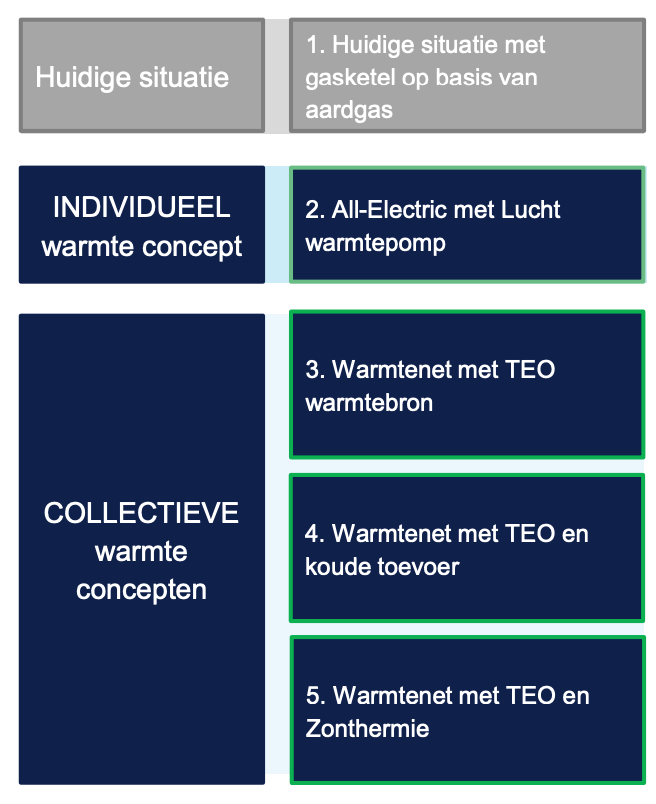
The criteria on which the various concepts were assessed:
- CO2 emissions;
- Cost;
- Nuisance during construction and use;
- Electrical energy supply needs;
- Peak electrical power need – the highest demand for electrical power measured over a certain period of time; and
- Flexibility.
Based on these criteria and in collaboration with RES Regio Rivierenland, it was concluded that heat extraction from the Linge with one heat-cold storage is currently the best technology for a sustainable heat supply to connect the village center of Enspijk.
A quick scan was then carried out by Royal Haskoning DHV to investigate whether this would also be technically feasible. The conclusion was: it is feasible. However, there is a significant financial challenge.
Based on this information the DWE working group started working in March 2022. During 2022, the DWE working group developed the Plan of Action. The Cooperation Duurzame Warmte Enspijk was founded on January 18, 2023.
Timeline
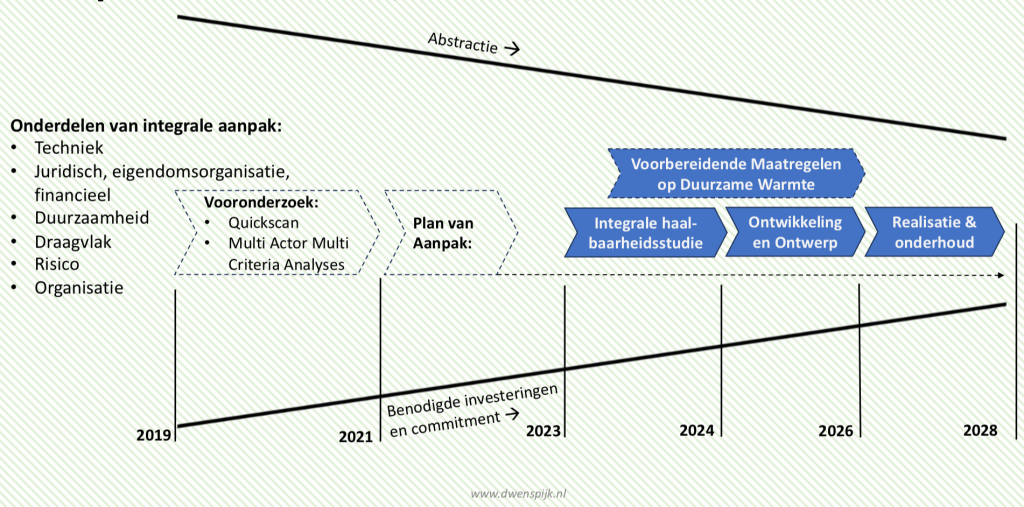
Activities March 2022 – February 2024
Every month small and large steps are being taken.
On this page you find an overview of the progress we have made so far. More news can be found on our newspage.

Participate!
Would you also like to actively contribute to the realisation of the communal heating system in Enspijk?
Send a message to info@dwenspijk.nl
 Duurzame Warmte Enspijk